How To Play The Game Of Kalooki
Kalooki is a game from the Rummy Family using 2 decks and 2
jokers - total 106 cards. It can be played with between 2 to 5
players. A complete game of Kalooki consists of several rounds
of game-play, where players try to dispose of their cards as
quickly as possible. The value of the cards still in-hand at the end of each round, makes up your score.
Penalty points usually determines the winner, although you can play who wins most hands. Kalooki is enjoyed by players of all ages. It can be played for fun - or for real money stakes. It is especially popular in the UK where it is played in
homes, clubs and casinos nationwide.
Card Values
Aces = 11 points
Picture cards = 10 points
10's - 2's = face value
Jokers = 15 points

Forming Sets Of
Cards In-Hand
Players create sets (or melds) of 3 or
more cards in a group or sequence.
A correctly grouped set is 3 or 4 cards of the same value but different suits.
Correct set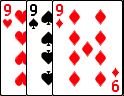
Incorrect set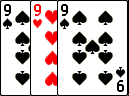
A correct group cannot have 2 cards of
the same suit.
Only one diamond, club, heart or spade.
Correct set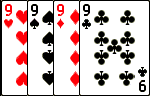
Incorrect set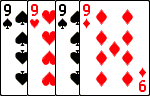
A sequenced set is 3 or more cards of consecutive value in the same suit.
Correct set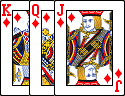
Incorrect set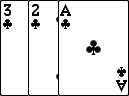 **
**
The lowest run is 2-3-4. The highest is
Q-K-A.
Aces cannot be part of a low run. ie: A-2-3**
Correct set
Incorrect set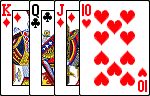
A run can be of any length, providing that all cards are of the same suit.
Correct set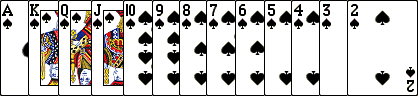
The Standard Game Of Kalooki
This explains the standard game of Kalooki, which is usaully played up to a 150 penalty point limit. Penalty points are calculated from the cards that remain in-hand for a player at the end of each round. Other variations in game play, scoring and stakes can be found in the 'Advanced Options' section.
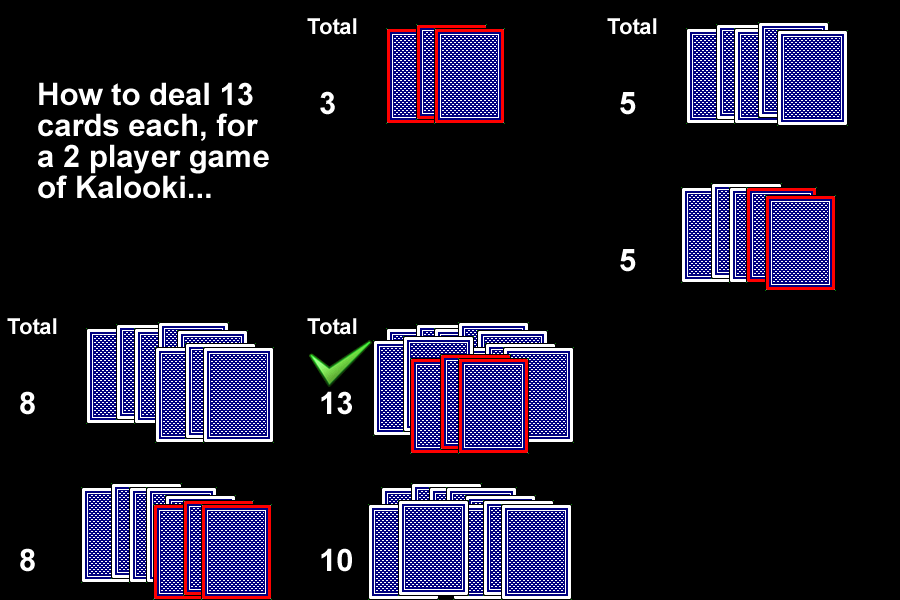
13 cards are dealt out to each player in groups of 3's and 2's - in a clockwise direction. First of all the dealer deals 3 cards to each player, starting with the player immediately to their left. Then two more cards to each, 3 more, 2 more and then finally 3 cards each.
This is the 'official way' to deal out 13 cards.
The
remaining pile is placed face down on the table, forming
the card stock (or 'deck') required for the game.
(Some people turn the top card of the deck, to start
the discard pile, straight after the deal. We prefer
not to!)
The player to the left of the dealer goes first, taking an extra card in-hand from the top of the deck. They must then select one of their 14 cards to discard, placing it face up on the table, forming a new pile next to the deck.
Players must organise their in-hand cards into sets, deciding which to keep and which to throw away. Each player must 'draw' (take) a card at the beginning of their turn... and then discard one at the end.
Any reduction of points by laying sets or 'go-ers' must be done after drawing... and before discarding.
The game passes round in a clockwise direction. Subsequent players then have the choice of either taking the top card from the deck - or the top card from the discard pile, thrown by the previous player. A discard card can only be taken if it is required to complete a set which is then used **immediately. It cannot be taken from the discard pile and then held in hand for future use.
Laying Sets On The Table - "Coming Down"
Once the total value of cards that form sets in-hand reaches 40 points or more, a player has the option to lay these as declared sets, face up on the table into their relevant groups. This is called "coming down" and will reduce the players in-hand penalty points accordingly. When to come down is at the discretion of each player. **If a player wishes to take a discard, then it must be used within a set and immediately placed on the table, either as part of their compulsory 40+ points - or subsequent to them already having tabled their 40+ points.
30 points
plus
27 points
= 57 points
can then lay sets of any value for the remainder of that round.
Laying Cards On The Table - Adding "Go-ers "
Cards can also be added onto any declared sets that are 'exposed' on the table, either to extend a run... or to make a 3 of a kind set into a set of 4 of a kind. This can only be done when the player in question has already 'come down' and tabled their own set(s) worth 40+ points. Placing a card onto a tabled set is called adding a "go-er" and will also reduce potential penalty points. A discard card cannot be taken and then used as a go-er.
Add the 10 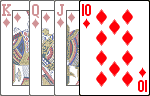
Add 9 clubs 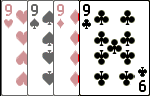
The Etiquette Of Declaring "Last Card"
If a player has tabled all but one of their cards and just has a single card in-hand during a round, they should declare this by saying "last card" to the other players at the table, as soon as they have made their discard. Not doing so is frowned upon... and some people actually will play with a rule stating that a person with 1 card remaining cannot call and finish the round until they have made this clear to the others, even if they find a suitable go-er from the deck on their next turn... although officially this is not the case!
Using Jokers
A joker can be used in the place of any card, either in-hand within a set, or as a go-er on the table. It assumes the position and value of the card it replaces. It must be clear to all players which cards the jokers represent.
Jokers will be scored at their maximum value of 15 points if they remain in-hand at the end of a completed round of game play. (When a player 'calls up' and the other players in-hand penalty points are added to their scores).
Joker in place of Queen of Clubs 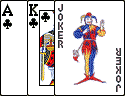
Re-using Jokers
A joker that is part of a declared set, face up on the table, can be re-used by any player on their turn, providing that they have already come down with 40+ points and can replace the joker with its natural card within the set.
The joker must be used immediately within a new set and cannot be held in-hand for future use... nor can it be placed as a go-er, elsewhere on the table. The following is an example of how a used joker could be taken...If a joker is in a set with10 Diamonds and the 10 Spades,
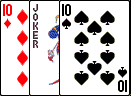
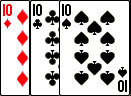
then it could be replaced... by a natural 10 Clubs
or by a natural 10 Hearts
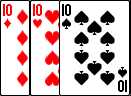
When a declared joker has been used in a 3 of a kind set, it can be taken by either natural replacement card. When the declared joker is in a 4 of a kind set then only the last remaining natural card can be used to take it. When any declared joker is part of a run, it can ony be taken by the card that is its exact natural replacement.
Alternative Rule For Re-Using Jokers
There is an alternative to the rule for re-using jokers that is almost as popular as the one previously explained... It states that when a joker is used in a grouped set, as above, BOTH natural replacement cards are required to 'take' it. In the example above... the 10 of clubs and the 10 of hearts would both be needed to take the joker.
Winning A Round Of Kalooki - "Calling-Up"
Once a player has successfully disposed of all 13 cards and then discarded, the remaining players must add the total values of all cards still left in-hand. These penalty points are recorded for each player and are referred to as the scores. The player calling incurrs no penalty points... Initially each player start with a score of zero.
Winning The Game
As subsequent rounds of the game progress, the players scores increase. When the cumulative score for a player exceeds 150 points they are out of the game! (on 151 or more) The next round continues without them... and they have no further involvement in that game.
When just one player remains... on a score that is not over 150 penalty points... they are the winner.
Advanced Options
There are a couple of additional elements that can be incorporated into a standard game of Kalooki, especially when playing for real money stakes. These are round by round payments... and buy-ins.
1) The option to "buy-in" if a players score exceeds the penalty point limit.
2) Playing each round of the game for an additional reward payment.
Stakes and rule variations must be agreed by all players before the start.
"Buying In"
When a players score exceeds 150 penalty points then they would normally be excluded from the rest of the game, however buy-ins enable such players to rejoin the game for an additional stake. This amount is usually half of the original game stake. They can then rejoin the game on a score that is equal to the player with the highest score. (150 points or less) The number of times that players can buy-in must be agreed in advance.
Kalooki is usually played with 1 or 2 buy-ins... however it is possible to play with unlimited buy-ins! Buy-ins are not allowed when just 2 players remain. (There must be 3 or more players still in the game.) Upon rejoining the game, it is usual to circle or bracket the buy-in players score on the sheet.
Hand by Hand Payments For The Winner Of Each Round
In addition to the main stake for a game, players may decide to play each round for an extra payment. This amount is usually 1/4 of the main stake value. If a player calls the round by laying all thirteen cards in one turn this is called a 'bomber' or a Kalooki and commands a higher reward, usually 1/2 the main stake amount. eg: If the initial stake for the game was £4, then each round would be played for an additional £1, with a 'bomber' or Kalooki worth £2. Buy ins would cost another £4. (The same amount as the game.)
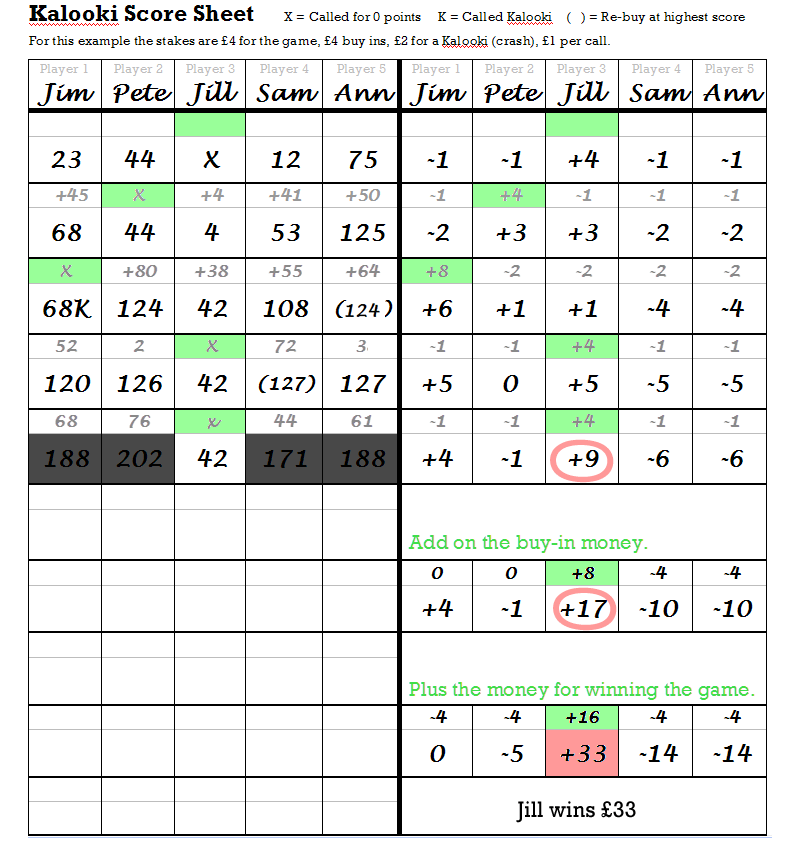
Hand by hand payments should be recorded alongside the penalty point scores for each player on the score sheet. The example below shows the penalty points on the left, with the hand by hand tally on the right hand side.